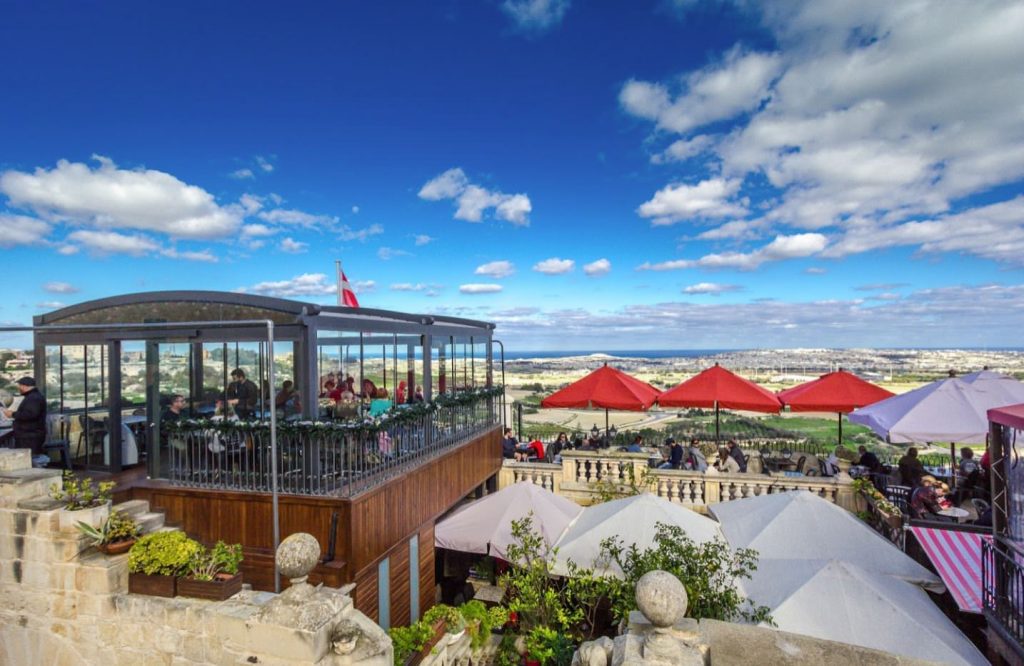

Some restaurants are defined by what they serve. Fontanella Tea Garden is defined by where it sits. Built into the bastion wall on the northern edge of Mdina — Malta's fortified medieval capital, known affectionately as the Silent City — Fontanella's open-air terrace looks out across the entire central plain of the island, all the way to the sea. The view alone would have been enough. The fact that the kitchen also produces one of the most famous chocolate cakes in Malta is, by any reasonable measure, a bonus.
For decades, no visit to Mdina has felt complete without a stop at Fontanella. The pattern is almost ritual: walk through the Main Gate, wander the limestone alleyways, find your way to the bastion edge, and order. A slice of chocolate cake. A cappuccino. A Maltese platter. A glass of wine at sunset. The menu adjusts to the hour; the view does the heavy lifting.
A cafe on Mdina's bastion edge
Mdina is one of Europe's oldest continuously inhabited cities. Its origins reach back more than four thousand years, and its current form — fortified walls, narrow streets, honey-coloured limestone palazzi — owes most of its character to the Knights of St. John, who refortified the city after the earthquake of 1693. Inside the walls, cars are forbidden, sound carries strangely, and the population is small enough that the city earned its nickname: il-Belt is-Skiet, the Silent City.
Fontanella's address — Bastion Street — tells you everything about its geography. The terrace does not face inward onto Mdina's plazas; it faces outward, over the wall, north toward Mosta, Mtarfa, the central plain and the distant coast. The seating cascades down two levels along the bastion edge, with the lower terrace dropping further still. On a clear day the horizon includes the dome of the Mosta Rotunda — itself one of the largest unsupported domes in the world — and beyond that, a thin blue line of sea.
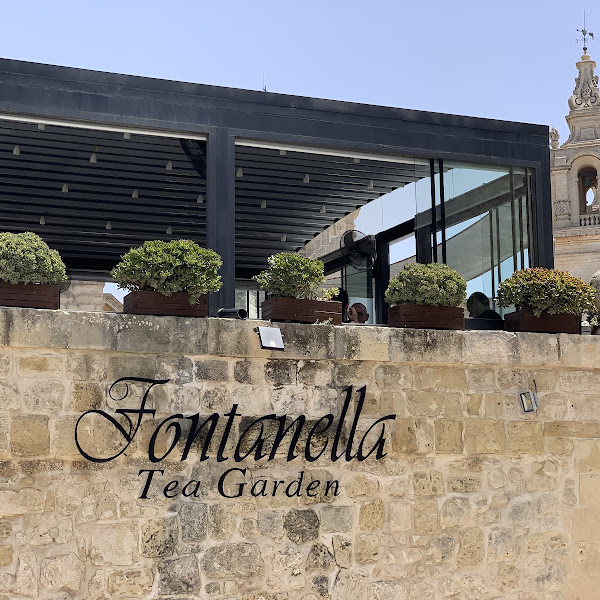
Built into the wall, looking outward
The terrace runs along Mdina's northern bastion. Tables sit on the parapet edge, with the medieval wall beneath them and the entire central Maltese plain spread out below.
Indoor seating exists — a series of stone-vaulted rooms that catch the breeze on hot days and offer shelter when the bastion winds pick up. But the terrace is what guests come for. Reaching it is part of the experience: through the door, past the cake counter, up or down a short flight of steps depending on the season, and out into the open air. The first view from the bastion almost always elicits the same reaction. People stop walking, lift their phones, and look.
The view: Malta from a fortified seat

Fontanella's panorama is one of the most generous on the island. Because Mdina sits on a rocky plateau in central Malta, the city walls function as a natural balcony. From the terrace you can pick out:
- The Mosta Rotunda — visible to the north-east, its enormous dome unmistakable against the skyline.
- Mtarfa — the hilltop town directly opposite, with its distinctive clock tower.
- Saint Paul's Bay and Bugibba — the northern coastline, on clear days.
- The Victoria Lines — the 19th-century British fortifications that run east–west across central Malta, traceable from the bastion as a line of green and grey.
- Farmland and rubble walls — the patchwork of small fields that defines the Maltese interior, with its dry-stone ħitan tas-sejjieħ dividing centuries-old plots.
The light changes throughout the day. Mornings are clear and quiet, the inland farmland still cool. Midday brings the highest contrast and the busiest service — the cake counter rarely stops moving between noon and three. Late afternoon turns the limestone gold, and the terrace begins to fill with guests timing their slice to coincide with sunset. After dusk, Mdina empties of day-trippers and the cafe takes on a different rhythm — slower, quieter, more local.
The chocolate cake that became a landmark
Talk to anyone who has visited Mdina more than once, and Fontanella's chocolate cake will come up. It has acquired a reputation that exists somewhere between dessert and cultural institution. Visitors who would not ordinarily think to write home about a slice of cake routinely write home about this one.
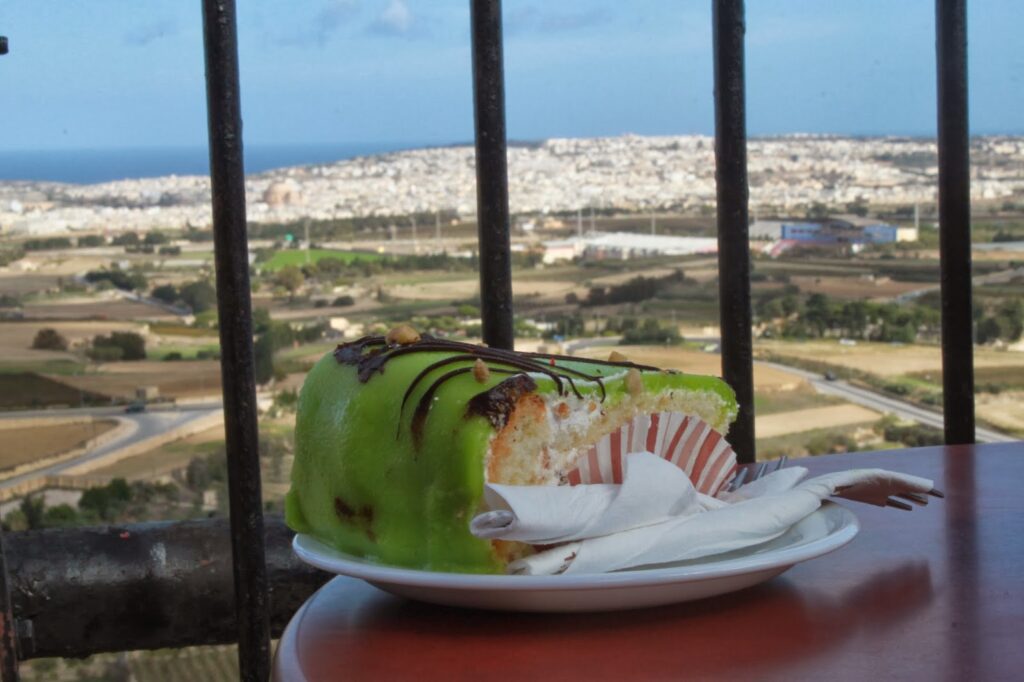
The Fontanella chocolate cake
Dense, dark and generously layered. Closer to a fudge cake than a light sponge. Served in slabs from the counter and routinely cited as one of the best chocolate cakes in Malta.
What makes it work is restraint. The cake is not architecturally ambitious. There are no gold leaves, no edible flowers, no smoke-and-mirrors plating. It is a thick slab of dark chocolate sponge layered with chocolate cream, sometimes finished with a glossy ganache, served on a plain plate. The flavour is rich enough that a single slice is usually enough — though many guests order two anyway.
The wider cake counter rotates through an impressive selection. Carrot cake, Victoria sponge, lemon tart, cheesecake variations, traditional Maltese sweets, seasonal specials — the bakery does not stop at the chocolate flagship. But the chocolate is what people queue for, and what almost every guest photographs before lifting their fork.
Traditional Maltese platters & the kitchen
Fontanella's reputation rests on the cake counter, but the savoury menu is more capable than casual visitors expect. The most representative order — and the one most worth choosing if you want a sense of traditional Maltese cuisine in a single dish — is the Maltese platter.
🧀 Traditional Maltese Platter
A sharing board built around Malta's pantry staples: ġbejniet (small rounds of sheep's-milk cheese, fresh or peppered), Maltese sausage (coarse pork, fennel, garlic and parsley), sun-dried tomatoes, olives, capers, bigilla (broad-bean dip), and a basket of ftira (Malta's flat sourdough). It is the closest the island gets to a culinary postcard on a plate.
🍝 Pasta & pizza
The lunch menu runs through Italian-Maltese pasta classics — ravjul (Maltese ravioli filled with ġbejna and ricotta), spaghetti with seafood, and a range of pizzas baked to order. Hearty rather than refined; consistently honest.
🥖 Ftira open sandwiches
A quicker option — Mdina sourdough loaded with combinations of tomato, tuna, capers, olives, ġbejna and Maltese sausage. Designed for travellers who want to eat traditionally without committing to a full lunch.
🍷 Coffee, tea and local wine
The drinks list is built for the terrace: espresso, cappuccino, hot chocolate, a broad tea selection (the name Tea Garden is not accidental), Maltese wine by the glass and bottle, and Cisk — Malta's hometown beer — on draught.
What the kitchen does not try to be is fine dining. Mdina has restaurants for that — formal palazzi serving tasting menus by candlelight. Fontanella's role is the opposite: a relaxed, all-day, all-ages stop where the menu supports the view rather than competing with it.
Pairing Fontanella with the Silent City
A visit to Fontanella works best when it is woven into a broader Mdina itinerary rather than treated as a standalone destination. The Silent City is small — you can walk its perimeter in under thirty minutes — but rewards slow exploration. A common pattern:
- Enter through the Main Gate. The arched entrance featured in Game of Thrones (King's Landing, season one) is itself a photo stop. The bridge across the moat dates from the Knights' refortifications.
- Wander to St. Paul's Cathedral. Mdina's seat of the archbishop, designed by Lorenzo Gafà in the 1690s after the earthquake. The cathedral square is one of the city's quietest corners.
- Slip into a side alley. Mdina's appeal is in its narrow lanes — Triq Villegaignon and the smaller streets off it reveal palazzi, wrought-iron balconies and the occasional courtyard glimpse.
- Reach the bastions. Walk to the northern edge of the city. Fontanella is signposted; you will not need a map.
- Order, sit, look. Cake at the counter, table on the terrace. Allow at least an hour.
- Continue to Rabat. Mdina opens directly onto Rabat, where St. Paul's Catacombs, the parish church, and a denser collection of restaurants and bars are all within five minutes' walk.
For a deeper Mdina visit, our Mdina Guide covers the full circuit. For Mdina dining specifically — including the formal restaurants inside palazzi — see the Mdina Dining Guide.
How to visit
Address & contact
- Location: Bastion Street, Mdina, Northern Region, Malta
- Phone: (+356) 2145 4264
- Website: fontanellateagarden.com.mt
- Restaurant page: Fontanella Tea Garden on HubpyMalta
Getting there
- By car: Park at the Mdina Main Gate / Rabat parking area. Mdina is car-free inside the walls; the walk from the car park to Fontanella is under ten minutes.
- By bus: Routes 51, 52, 53, 56 and 186 stop at the Mdina/Rabat terminus.
- From Valletta: Approximately 25–35 minutes by car or bus depending on traffic.
- From Sliema/St. Julian's: Approximately 30–45 minutes.
When to go
- Morning (9:00–11:30): Quietest terrace, clearest inland views, freshest cake selection.
- Lunch (12:00–14:30): Busiest service — call ahead for table dining.
- Late afternoon / sunset: The most photogenic light. Slower service, longer table turns.
- Evening: Mdina empties; the cafe takes on a quieter, more local atmosphere.
What to order
- If you only order one thing: The chocolate cake. Black coffee or espresso to balance it.
- For a full visit: Maltese platter to share, then chocolate cake, then a tea or cappuccino on the terrace.
- For lunch: Ravjul or a pizza, finished with cake.
- For sunset: A glass of Maltese wine or a Cisk, plus a slice of cake to share.
Get the Malta Food Insider
One email a month with new openings, hidden gems and seasonal menus across the island. No spam, unsubscribe anytime.
Frequently asked questions
Where is Fontanella Tea Garden in Malta?
Fontanella sits on the bastion edge of Mdina — Malta's fortified medieval capital, known as the Silent City. A few minutes' walk from the Main Gate, with a terrace looking out over central and northern Malta.
What is Fontanella famous for?
Two things above all: its homemade chocolate cake — a thick, dense slice that has become a Mdina landmark in its own right — and the bastion terrace, which offers one of the widest panoramic views on the Maltese islands.
How do I get to Fontanella in Mdina?
Mdina is car-free inside the walls. Park at the Mdina Main Gate or Rabat parking area, then walk in through the Main Gate and follow the signs to the bastion edge. Bus routes 51, 52, 53, 56 and 186 stop at the Mdina/Rabat terminus.
Do I need to book a table?
For coffee-and-cake on the terrace, walk-ins are the norm. For lunch at peak hours (12:30–14:30) and prime sunset seating, calling ahead on (+356) 2145 4264 is recommended — especially on weekends and public holidays.
What should I order?
The chocolate cake is non-negotiable. For something savoury, the Maltese platter — ġbejniet, Maltese sausage, sun-dried tomatoes, olives, capers, bigilla and ftira — is the most representative dish. The lunch menu adds pastas, pizzas and ftira sandwiches.
Is Fontanella suitable for families?
Yes. The terrace and cake counter are family-friendly, with relaxed table service and a casual atmosphere. The Maltese platter is a natural sharing dish, and children typically enjoy the bastion view itself.
What time of day is best to visit?
Mornings are quietest and offer the clearest inland views. Late afternoon and sunset are the most photogenic. Lunch (12:00–14:30) is the busiest service. Each hour has a different mood — pick what fits your itinerary.
Can I sit on the terrace without ordering a meal?
Yes. Fontanella works equally well as a coffee-and-cake stop. Order a slice and a drink and the terrace seat is yours — a full lunch is not required.
Is the chocolate cake really worth the hype?
Fontanella's chocolate cake has been a Mdina landmark dessert for decades. It is dense, generously layered and richer than a standard sponge — closer to a fudge cake than a light gateau. Whether it's the "best in Malta" is taste, but it's unquestionably one of the most photographed slices in the country.
How long should I plan for a Fontanella visit?
Plan at least one hour. Walking from the Mdina Main Gate to the cafe, ordering, getting a terrace seat and enjoying the view — together that's an unhurried hour. Sunset visits often stretch to ninety minutes. Add another two to three hours if you want to combine with a proper Mdina + Rabat tour.